In the late 1800’s, Thomas Edison and Nikola Tesla fought to determine the fate of our nation’s electrical grid. Tesla’s Alternating Current (AC) technology won the day, setting the foundation for our modern electrical grid.
Our nation’s electric grid is often referred to as “The World’s Largest Machine”, comprising over 12,500 power plants, 60 million distribution transformers, 180 million power poles, and 6 million miles of cable – that’s enough to wrap around the world’s equator approximately 240 times. These assets are owned by roughly 3,000 private, municipal, and federal utility companies that all have different preferences, and the assets physically cross through public and private property, complicating how we manage and maintain our nation’s patchwork grid. Despite many of the grid’s components being between 50 and 100 years old, it still functions reasonably well, but can’t keep up with the demands of decarbonization and the growth of data centers.
The grid’s problems go deeper. The fundamental design of our grid is the result of 120+ years of accumulated, ad-hoc decisions that don’t make sense in Industry 4.0.
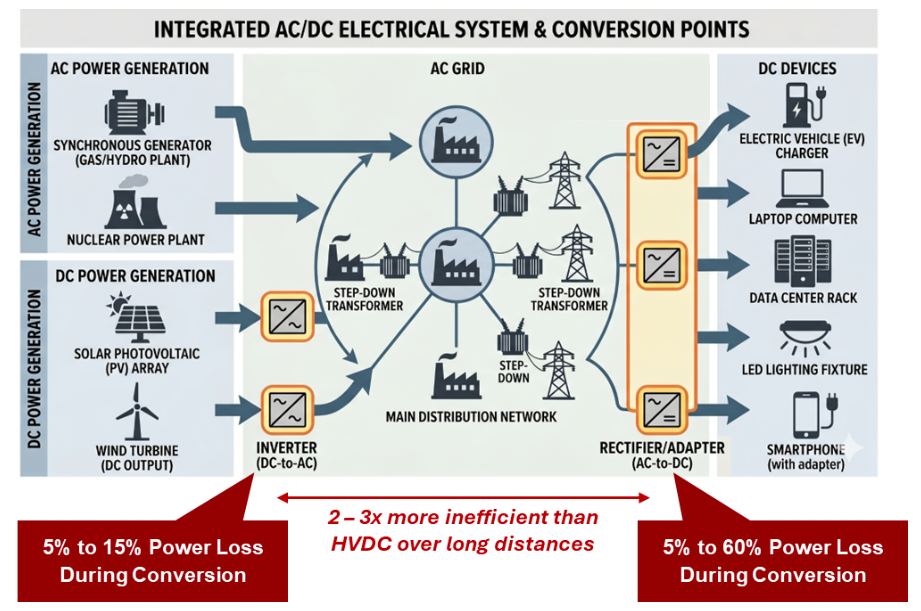
Global technology has shifted towards Direct Current (DC) power while our legacy grid is still built for AC. There is a shift towards DC power generation underway. Solar and Wind power are not only the cheapest sources of electricity (even before incentives), but they are gaining market share as well. The US Energy Information Administration estimates that Solar and Wind (DC power) now comprise 18% of the total source of US electricity.
There is no consensus on what percent of devices and appliances natively operate on DC; estimates range from 30% to 50%; but nearly all industry experts agree that a shift is underway towards native DC devices and appliances. LED lights, computers, anything with a battery (including electric vehicles), modern HVAC equipment, and datacenters are all natively DC. Native AC devices are simply old tech.
Yet, our AC grid sits in the middle of it all, and conversion back and forth between AC and DC power is massively inefficient.
The World’s Largest Machine is an analog, mechanical system in today’s digital era. Our grid is designed around a just-in-time power model where the power plants need to adjust their output in real-time to match demand. Failure to do this quickly will result in system failure.
Most AC power generators are massive spinning metal turbines inside coal, gas, and hydro plants. When demand for power fluctuates, mechanical transformers and controls are used to physically spin-up or slow down these turbines and ensure the grid’s voltage and 60 Hz frequency is maintained.
These mechanical transformers and controls carry higher safety risk (arcing and fire) than the newer solid state technology, and the turbines’ physical inertia prevents instantaneous response to a large drop in supply (e.g. a whole power plant unexpectedly going offline), resulting in cascading failures. This is why we all use an array of Uninterruptible Power Supplies (UPSs) in our buildings and homes; to compensate for the grid’s lack of resiliency.
When there’s a large increase in demand (e.g. a hot summer day), our grid needs to rapidly turn on “peaker plants” to generate extra electricity. These peaker plants usually contain gas- or oil-fired turbines; they cost considerable money to build but are only used 5% to 15% of the year; otherwise they sit idle. And a unit of electricity generated by these peaker plants costs about 10x more than a unit of electricity generated by solar.
Power routing throughout the grid is passive; electricity distribution flows one-way from the central power plant to customers downstream. While the highest levels of the transmission grid have centralized digital controls, the “last mile” of the distribution network (the largest part of the grid) is manually operated; workers in bucket trucks must physically pull switches.
The grid’s physical configuration carries additional resiliency risk. Our grid’s hub-and-spoke model and one-way flow means that an incident upstream affects everyone else downstream. The lack of bidirectional flow in the grid also severely limits how you can add additional power generation into the system; physical constraints prevent the grid uptake from Distributed Energy Resources (like a neighborhood of rooftop solar panels).
Most of our distribution lines are also strung between countless poles, which are routinely vulnerable to ice storms, squirrels, and falling branches. Maintenance for these elevated lines is frequent, expensive, and often involves disrupting roadway traffic. And they are also just an aesthetic eye sore.
The case for Electric Infrastructure 2.0
While our electrical grid works, its inefficiency and vulnerability will become more evident as humanity ventures deeper into Industry 4.0. Demand for electricity is ever-increasing and our businesses and citizens deserve affordable, reliable, and safe electric service. Yet the grid owners are approximately $1 Trillion in debt; the average consumer cost of electricity is outpacing the Consumer Price Index (CPI) by over 2x; and J.P. Morgan estimates that an additional $1 Trillion in grid investments are needed by 2035 to address capacity and resiliency.
This begs the question of whether a $1 Trillion dollar investment in the current grid makes sense; or if it’s time to reinvent the grid from a blank canvas. Such a reinvention would include a new standalone, end-to-end DC grid, with energy storage for instantaneous response to supply or demand changes, solid state transformers and switchgear, software-based routing, and underground last-mile distribution (co-located with fiber and water).
Done correctly, the unit cost of electricity on the new DC grid will be so low for large industrial consumers (data centers, DOTs, hydrogen hubs, water treatment plants, etc.), they will naturally prefer to connect to the new DC grid. The interconnect backlog on our AC grid will be eliminated, and this results in a surplus of AC electricity for households.
The engineering solution can begin in a one or more local jurisdictions, which can be interconnected over time. This allows for initial proof-of-concept and long-term scalability.
Status of solution:
- Enabling policy concept
- Engineering concept and implementation roadmap