
“Industrial Revolution” was a term coined in the late 1700s to describe France’s race to industrialize. What followed was a global movement that harnessed the power of water and steam to mechanize production. The economic impact was profound; triggering sustained wage, economic, and population growth.
The Second Industrial Revolution started in the 1870s when steel replaced iron, and electricity and petroleum fueled mass production. The Third Industrial Revolution emerged in the 1960s with the advent of the microprocessor, enabling digital technology to eventually automate production. The Fourth Industrial Revolution (Industry 4.0) was first described in 2011 as the era of internet-connected manufacturing, and a shift from “automated” process to AI-driven “autonomous” robotics.
According to the World Economic Forum, “The technological advances of the Fourth Industrial Revolution have fundamentally altered society in ways both seen and unseen. This digital transformation has changed how people live and work, and everything inbetween. One area of daily life, however, seems to be largely missing out on this revolution: infrastructure. It remains one of the least digitally transformed sectors of the economy. While individual examples of highly advanced infrastructure systems exist, the sector at large lags behind others in innovation.”
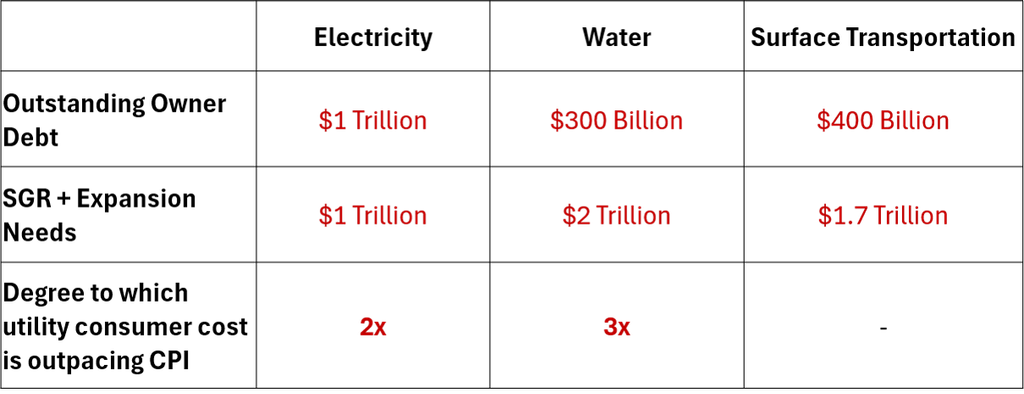
Our energy, water, and surface transportation systems are also on an unsustainable fiscal path. We are building slower; and when we do it’s too expensive. State of good repair backlogs are deepening, and costs to consumer outpacing inflation.
Failure to reinvent our civil infrastructure, from a clean sheet of paper, poses risk that affects every citizen.